Vault tracks the progress and completion status of Learners through each Curriculum they are assigned. The system creates a Curriculum Completion Status object record for each training path, or combination of Person (Learner) and Curriculum-Learner Role. This allows Training Admins and other stakeholders to set up reporting on the Curriculum Completion Status and Historical Completion Status objects to detail the training completion status of individual Learners at the Curriculum level.
Note: This feature applies to both Veeva Training and Veeva Study Training.
How Vault Calculates Completion
A curriculum’s completion status is reflected in the Completion Percentage field within the related Curriculum Completion Status record.
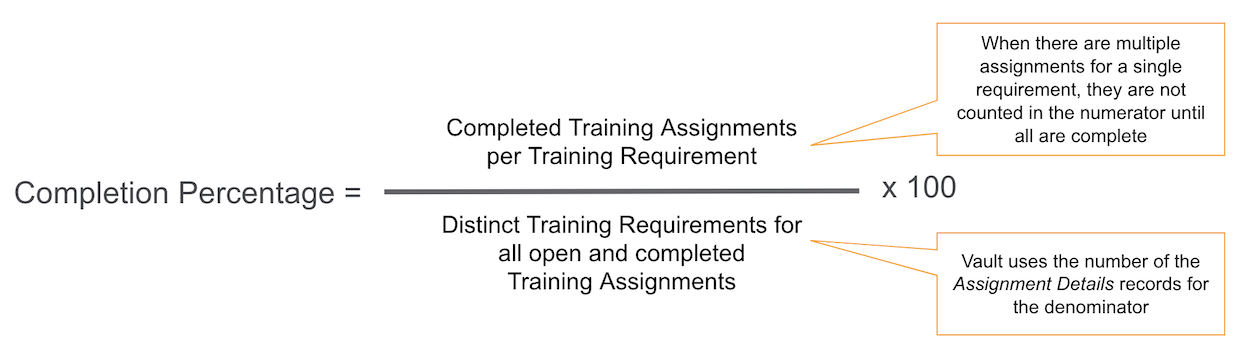
Vault calculates the percentage using the below equation.
See the use case below for a detailed analysis of the calculation.
About the Numerator
The numerator is calculated as total completed Training Assignments per Training Requirement for a Curriculum, where all assignments for a requirement are counted as one (1).
This means that, when there are multiple Training Assignments for a single Training Requirement, Vault only counts them as a unit when all assignments are complete. This count also depends on how the assignments were created.
About the Denominator
The denominator is calculated as the total count of distinct Training Requirements for all open and completed Training Assignments for a Curriculum.
Another way to determine denominator is to count:
- The number of Assignment Details records for each requirement’s related Training Assignments, or
- The number of Curriculum Completion Status (CCS) or Historical Completion Status records created for each Curriculum and Learner Role combination in the Learner’s training matrix.
- Vault uses the Historical Curriculum Completion Status object to track completion when Training Matrix updates result in assignment cancellation, such as marking a Learner as ineligible for training. See additional details about how Vault manages in-use and historical CCS records.
Open & Complete States
A Training Assignment and its Assignment Details record are considered to be complete (closed) in the Completed or Resolved state. Otherwise, the assignment is considered to be “open” when calculating completion.
Curriculum Completion Use Case
Suppose the following for a Curriculum on Instrumentation:
- The Curriculum contains five (5) total Training Requirements. For the sake of this example, they are Requirements A through E.
- One of these requirements (E) is configured to assign additional training for Effective versions. This means this requirement can have two (2) Training Assignments (depending on when they are made), for a total of six (6) potential assignments for this curriculum.
- Leslie Learner receives all six potential assignments, as the above requirement references two versions of the Training Material (an SOP on Instrumentation) when Vault creates her assignments for this curriculum:
- SOP v6.0 is Effective (the Steady State)
- SOP v7.0 is Issued (the Ready for Training state)
Completion Percentage Calculation
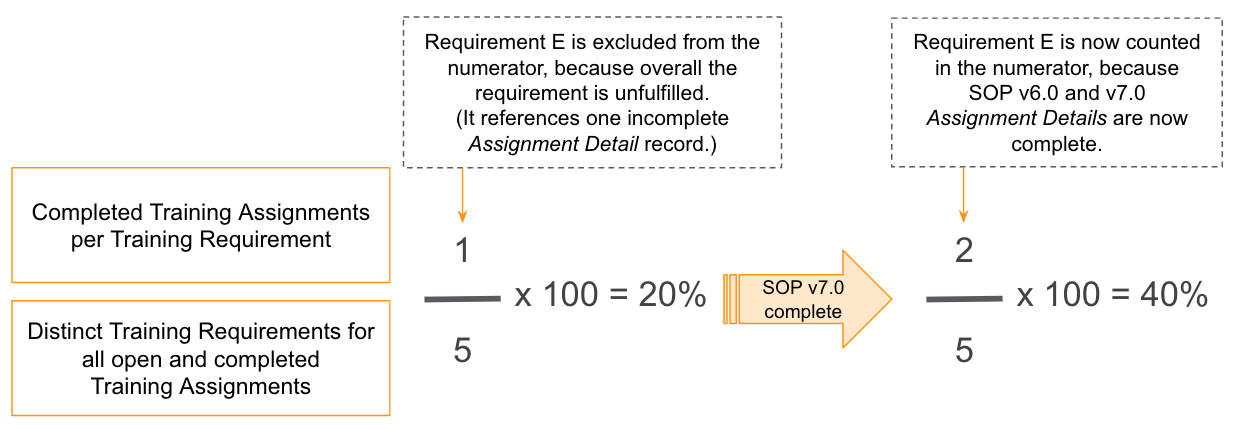
At a given time prior to completion, Leslie’s Completion Percentage is 20% (1 ➗ 5 x 100) with assignments broken down per the below.
- One (1) assignment (A) is complete. This means the requirement is fulfilled, and is included in the numerator.
- Three (3) assignments (B-D) are incomplete. This means the requirements are unfulfilled and are not included in the numerator.
- Requirement E is partially complete, as described below. This requirement’s one incomplete assignment means the requirement is unfulfilled overall and cannot be included in the numerator:
- Effective SOP v6.0 is complete
- Issued SOP v7.0 is incomplete
Continuing the example, when Leslie completes the assignment for SOP v7.0, Vault counts Requirement E in the numerator, as illustrated below. In the meantime, Requirement E is excluded because the numerator only counts complete Assignment Detail records.
Related Objects
Vault uses assignment- and completion-specific objects to track completion over time and to properly account for Training Matrix updates.
Assignment Detail
For the most accurate calculation, Vault counts a Training Assignment’s related Assignment Detail record to calculate Completion Percentage. This is required to account for Training Matrix configurations where a Learner is assigned a Training Requirement which can result in multiple Training Assignments.
See the Curriculum Completion use case and Configuring Veeva Training for more information about this object.
Curriculum Completion Status (CCS) & Historical CCS
Curriculum Completion Status (CCS) records actively track completion status as Learners complete assignments, and Historical Curriculum Completion Status records serve as a “snapshot” of these records in the event Training Matrix updates result in assignment cancellation, such as retiring a curriculum or marking a Learner as ineligible for training. This approach supports training data integrity by handling cancellation and re-assignment events in real time: When Vault creates or cancels an assignment, these objects allow Vault to properly reflect the count in the formula’s denominator.
To do this, Vault copies all relevant CCS field data, such as Completion Percentage and Last Completion Date, into a new historical record, then deletes the CCS record.
In the event the training path becomes relevant again (for example, the ineligible Learner becomes eligible), Vault references the latest historical record to create a new CCS populated with the relevant historical record’s data. In most cases, Vault copies historical field data to a new CCS record, however some fields are recalculated, including Completion Percentage, Completion Status, Latest Assigned Date, and Latest Automation Update.
Limitations
Training Assignments created via Direct Assignment, Self-Enrollment, or assigned as Substitute Training Assignments are excluded from Completion Percentage calculations.
Additionally, this feature does not support manually-cancelled Training Assignments. When a Training Admin manually cancels an assignment (likely via a custom, non-conditional user action on the assignment lifecycle’s Assigned state), Vault does not create a Historical Curriculum Completion Status record as it normally would for a system-cancelled assignment. Instead, it subtracts the assignment from the equation’s denominator, which can cause an incomplete curriculum to suddenly “flip” to complete. This can inaccurately suggest that the Learner met all requirements, when they only actually completed some of them before the assignment was cancelled.
Support
It is possible that a completion status is incorrect, most likely due to race conditions between Assignment Details lookup fields and related Vault jobs. If this occurs, you can contact Veeva Support to recalculate the Completion Status.